Even Your Caregiver Needs a Helper... and That Helper Is You

Updated: Aug 2
The best diabetes care doesn't happen when one person carries all the responsibility—it happens when you work together.
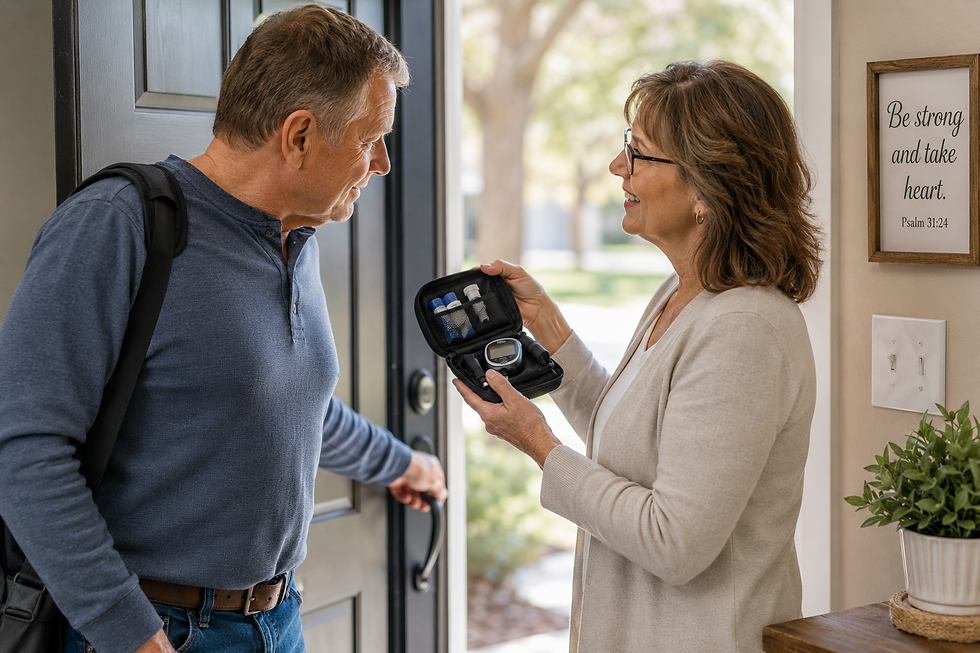
There were many times while caring for my first husband, Robbie, that I became mentally and physically exhausted. As a registered nurse, I also spent years caring for patients with diabetes, so I understood the seriousness of the disease. But understanding diabetes didn't make me immune to being tired.
Life doesn't stop because someone has diabetes.
There were jobs to go to, children to raise, groceries to buy, bills to pay, laundry to do, meals to prepare, doctor's appointments to keep, and countless other responsibilities that filled our days. Like many caregivers, I wanted to do everything I could to help the person I loved. But there were days when I was simply worn out.
During those busy seasons, it was easy for something small to be forgotten.
Sometimes the early signs of a low blood sugar were overlooked because we were both focused on everything else that needed to be done.
Sometimes an Accu-Chek was forgotten before taking insulin.
Sometimes we would be standing at the back door, ready to leave the house, when I'd stop and ask:
"Do you have your glucometer?"
"Your insulin?"
"Your needles?"
"Your glucose tablets?"
"Something to drink if your blood sugar drops?"
Sometimes the answer was...
"No."
Back into the house we'd go.
Those moments taught me something important.
No caregiver—no matter how much they love you—is perfect.
Caregivers get tired.
They become distracted.
They have responsibilities, worries, and days when they're running on very little sleep. They may be trying to balance work, family, finances, and the everyday demands of life while also helping someone manage a chronic illness.
That doesn't mean they don't care.
It means they're human.
One day I realized something that changed the way I looked at caregiving.
I wasn't supposed to carry diabetes by myself.
And Robbie wasn't supposed to let me carry it by myself.
Diabetes works best when both people become a team.
Just because you have a caregiver doesn't mean you shouldn't be actively involved in every aspect of your own care. Learning about your diabetes, recognizing the signs of high and low blood sugar, remembering your supplies, and speaking up when something doesn't feel right allows you to remain independent while becoming an even better partner in your care.
A caregiver can remind you, encourage you, and help protect you. But they can't live with diabetes for you. The more involved you become in your own care, the more you help your caregiver—and the more confidence, independence, and control you gain along the way.
One day, your caregiver may not be there. Illness, work, travel, or even a simple errand can leave you managing your diabetes on your own. Learning to understand your medications, recognize the signs of high and low blood sugar, and keep your supplies organized isn't just helping your caregiver today—it's preparing you to care for yourself tomorrow.

Being an active participant in your own care doesn't mean you're carrying the burden alone. It means you're sharing the responsibility with the person who loves you enough to walk beside you.
The strongest diabetes care doesn't happen when one person carries all the responsibility. It happens when both people work together, encouraging one another, watching out for one another, and sharing the responsibility one faithful step at a time.
One of my favorite Bible passages reminds us that God designed us to help one another.
“Two are better than one, because they have a good reward for their labor. For if they fall, one will lift up his companion. But woe to him who is alone when he falls, for he has no one to help." Ecclesiastes 4:9–10 (NKJV)


Comments